

Title: Spring 2026 Severe Weather Outlook: Why the Atmosphere Is Already Showing Its Hand
All signs pointing to an active Spring severe season.

The spring 2026 severe weather season has not waited for the calendar. An EF-2 tornado struck Bloomington, Indiana, on February 19, carving a 3.7-mile path with 120 mph winds and prompting a rare PDS tornado warning. At least six tornadoes were confirmed across southern Illinois and Indiana that evening. Severe storms swept from Texas to the Gulf States on February 14-16. Five tornadoes hit Oklahoma on January 8. Through mid-February, the U.S. had already logged roughly 23 confirmed tornadoes, multiple rated EF-2, before the climatological ramp-up of severe weather season has even begun.
These events are not random. They are early expressions of a large-scale atmospheric configuration that, by multiple measures, points toward an active spring for tornadoes and severe thunderstorms across the central and southern United States. The drivers are converging in a way that warrants detailed examination.
The ENSO Transition: Rapid Collapse, Potent Residual Signal
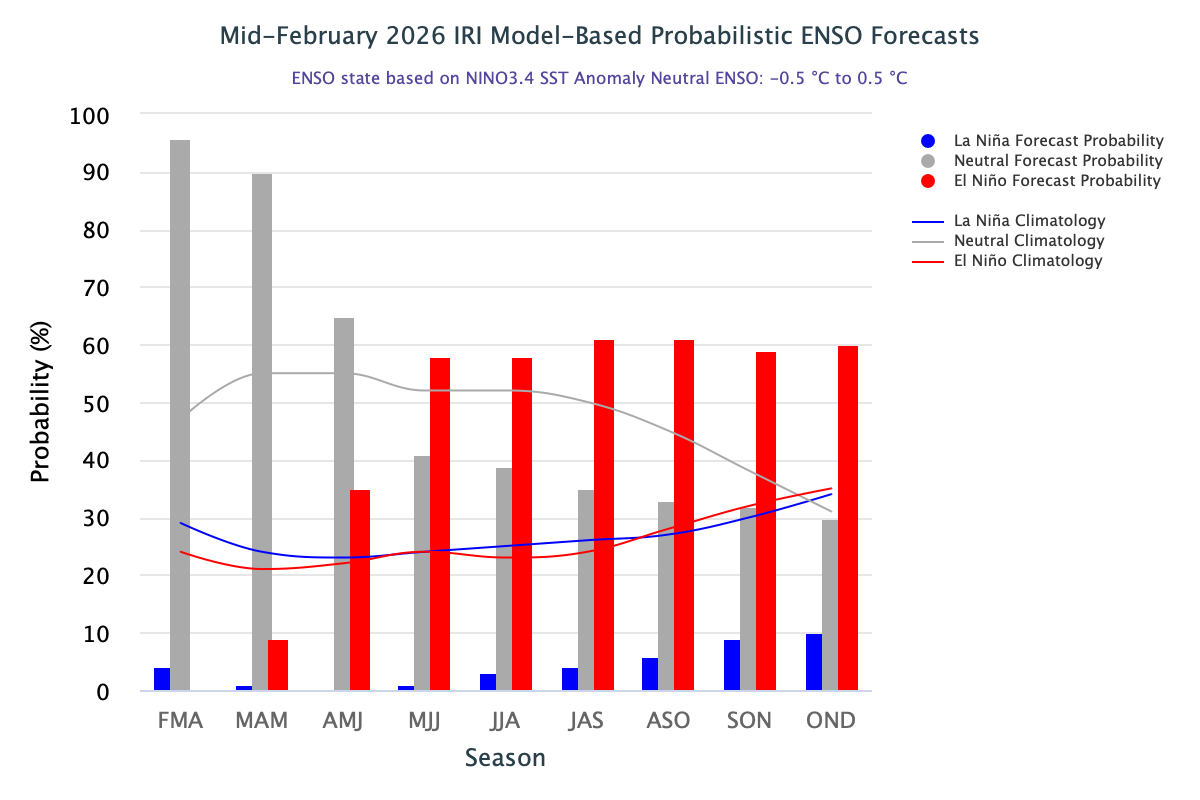
As of the most recent IRI quick look (mid-February 2026), the weekly Nino 3.4 index has risen to -0.2 degrees Celsius, a dramatic warming from the -1.10 degrees Celsius observed in December and -0.54 degrees Celsius in January. The La Nina is collapsing with remarkable speed. The IRI multi-model plume now places a 96% probability of ENSO-neutral conditions for the February-April period, with La Nina’s probability down to just 4%.
However, the atmospheric story is more nuanced than the Nino 3.4 trajectory suggests. CPC’s Relative Oceanic Nino Index (RONI), which became the official ENSO monitoring metric on February 2, 2026, measures SST anomalies in the Nino 3.4 region relative to the broader tropical mean. By this measure, La Nina’s influence has been substantially more robust: the RONI for the five most recent overlapping three-month periods (July-September through November-January) was -0.63, -0.77, -0.87, -0.93, and -0.97 degrees Celsius, respectively. That is a progressively intensifying cold signal through the RONI lens, even as the traditional ONI was showing weakening. The Copernicus C3S models also recorded a Nino 3.4 index of -1.05 degrees Celsius for the October-December 2025 three-month average.
This distinction between the two metrics is consequential for severe weather. The atmosphere responds to the actual SST patterns and their influence on tropical convection, the Walker Circulation, and the resulting teleconnections to mid-latitude jet stream behavior, not to a single index threshold. The La Nina signal embedded in atmospheric circulation this winter has been more impactful than a traditional “weak La Nina” characterization would suggest.
Research from Allen, Tippett, Lepore, and others has demonstrated that La Nina conditions enhance tornado-favorable environments across the south-central and southeastern U.S. through several mechanisms: a more amplified jet stream with increased troughing over the central U.S., more frequent cyclogenesis east of the Rockies, enhanced southerly moisture transport from the Gulf, and increased frontal frequency. These are the organizing agents for severe weather. Critically, these atmospheric patterns exhibit inertia. The jet stream configuration established during winter does not instantly recalibrate when the Nino 3.4 index crosses -0.5 degrees Celsius. The residual signal persists through the March-April severe weather window, which is precisely when climatological tornado frequency ramps up.
The analog years for La Nina-to-neutral transitions (2021, 2018, 2012, 2011, 2006, 2001, 1996) show high variance, but the extremes are notable. The 2011 transition produced one of the most catastrophic tornado seasons in U.S. history, including the April 25-28 Super Outbreak. That year also featured a rapidly collapsing La Nina with a strong residual atmospheric signal.
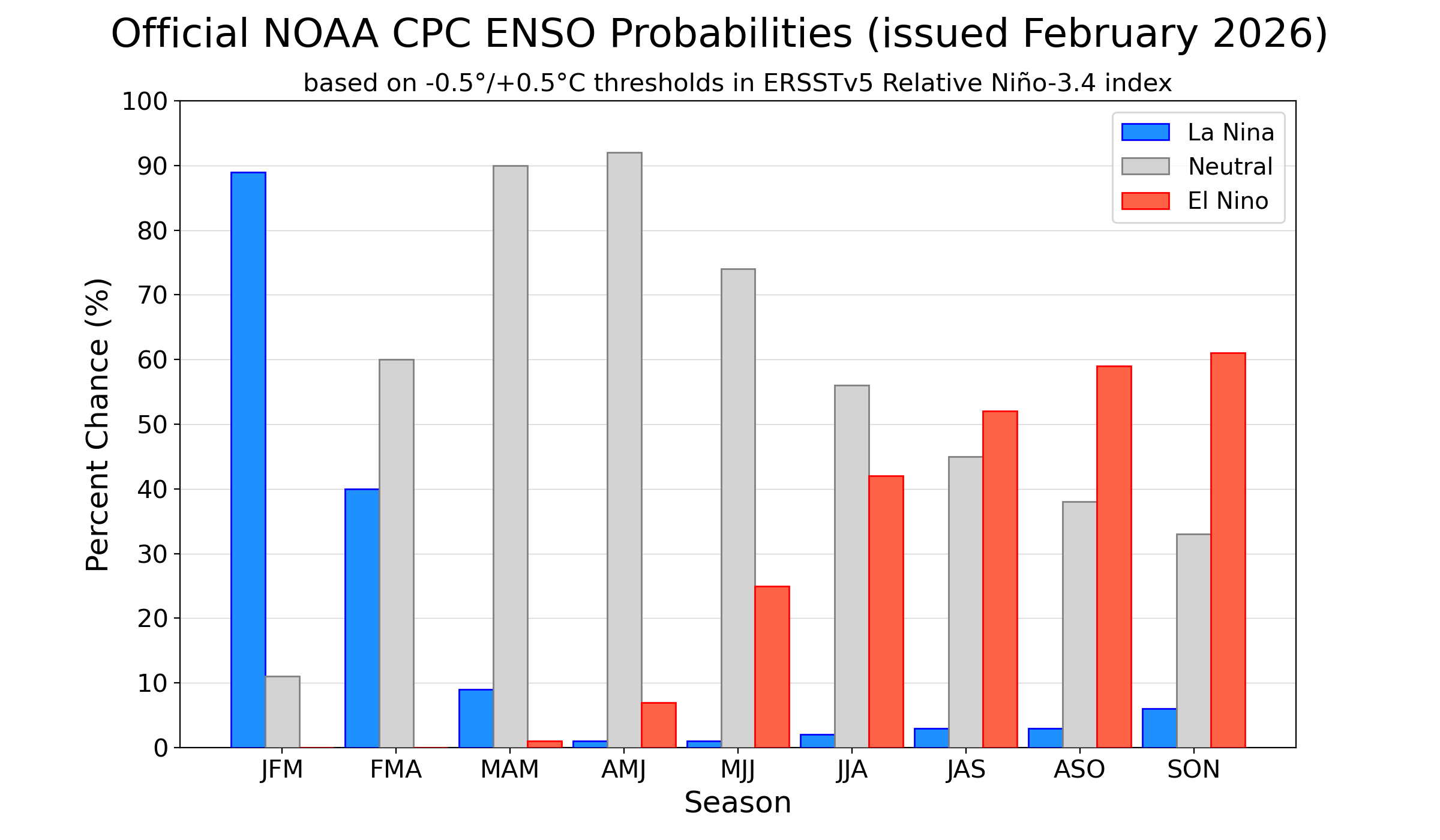
Looking further ahead, multiple modeling systems, including ECMWF, NMME, and the IRI plume, are showing El Nino probabilities rising through summer 2026. The Copernicus C3S models predict ENSO-neutral from March onward, with some models suggesting El Nino development as early as late summer. Rapid ENSO phase transitions can produce volatile mid-latitude patterns during spring as the tropical forcing evolves.
Stratospheric Forcing: The SSW Event and Persistent Cold Air Accessibility
The 2025-2026 winter featured a significant Sudden Stratospheric Warming event that caused a full polar vortex split in mid-February. The January-February 2026 North American cold wave, directly linked to the SSW-driven polar vortex displacement, caused an estimated $4 billion in damages and at least 22 direct fatalities. Record lows were set from Canada to Central America.
The February 19 tornado event in the Ohio Valley was a direct downstream product of this atmospheric configuration. The post-SSW pattern has maintained cold air accessibility at higher latitudes, so that when a transient shortwave trough ejects into the warm sector and surface-based instability develops, the thermal gradient across the frontal zone is anomalously sharp. That is exactly what happened last Wednesday: 70-degree temperatures in the warm sector across southern Indiana, cold air just to the north, and the resulting wind shear profile that supported supercells capable of producing EF-2 tornadoes.
The SPC’s Day 4-8 outlook as of this morning (February 24) notes that severe weather potential will remain low through the current forecast period as the atmosphere undergoes a pattern change. An expansive upper-level ridge is taking shape across much of the U.S., while a closed low develops across the Southwest. A frontal boundary will stall along the northern Gulf Coast, confining appreciable low-level moisture to the Gulf through the weekend. However, by early next week (Days 7-8), the SPC identifies a regime transition: a split-flow pattern (ridge over trough) with an arctic front pushing into the northern tier, followed by Pacific shortwave energy potentially overrunning the colder air mass across the Mississippi Valley into the Mid-Atlantic by early March.
This is the kind of synoptic cycling, active warm sectors followed by reinforcing cold air, that sustains multi-week severe weather episodes through March and April. The cold air supply is not going away. It is being periodically refreshed, and each time the warm sector rebuilds and a new trough arrives, the severe weather potential recharges.
Gulf SSTs and Low-Level Moisture Transport
Gulf sea surface temperatures are a critical modulator of severe weather, and the Gulf has been running warmer than average through this winter. Research from Molina et al. (2016) established the physical chain: warmer Gulf waters enhance evaporation, increase boundary-layer dewpoints, strengthen the low-level jet, and increase CAPE when that moisture is advected northward into the warm sector of mid-latitude cyclones.
The Gulf SST-ENSO relationship is well-documented. Gulf temperatures are negatively correlated with tropical Pacific SST, meaning La Nina periods favor warmer-than-average Gulf waters. The long-term warming trend in the Gulf (approximately 0.19 degrees Celsius per decade since 1970, roughly double the global ocean average, per research published in the Journal of Climate in 2023) acts as a background amplifier. Each successive spring season starts with a slightly warmer Gulf baseline, providing incrementally more moisture and energy for severe convection.
The combination of a warm Gulf, an active jet stream, and accessible cold air is the trifecta that produces the most consequential severe weather episodes.
Jet Stream Configuration and the Severe Weather Corridor
The spring 2026 jet stream pattern is being shaped by the intersection of the collapsing La Nina, the post-SSW polar vortex disruption, and Pacific blocking. The ECMWF and UKMO seasonal models both show a persistent low-pressure zone over Canada maintaining cold air accessibility, with above-normal precipitation favored from the northern U.S. through the Midwest.
The CPC seasonal outlook favors above-normal precipitation from the Great Lakes to the Ohio Valley and Appalachians, above-normal temperatures for the Northeast and Mid-Atlantic from March through May, and a continued severe weather corridor from the Mississippi Valley through the Gulf States.
AccuWeather’s seasonal team notes that storm systems this spring may track more slowly, increasing rainfall totals, flooding risk, and the duration of individual severe weather events. The greatest risk for severe weather is expected to focus from the Mississippi Valley into the Gulf States during March and April, expanding northward into the central Plains and Midwest during late April and May.
A Note on the SPC’s New Conditional Intensity Groups
One week from today, on March 3, the SPC will implement Conditional Intensity Groups (CIGs) in their Day 1, 2, and 3 Convective Outlooks. This is the most significant change to SPC forecast products in years.
For tornadoes, the system adds three intensity levels: CIG 1 indicates maximum forecast tornado intensity around EF-2. CIG 2 indicates EF-3 potential. CIG 3 indicates EF-4 or EF-5 potential.
For wind, three levels correspond to gusts up to 75 mph (CIG 1), longer-track events like bow echoes or derechos (CIG 2), and high-end derechos (CIG 3). Hail receives two levels: supercells capable of 2-inch hail (CIG 1) and very large hail of 3.5 inches or more (CIG 2).
These replace the old “significant” hatched area, which only conveyed a 10% probability of significant severe weather without differentiating between an EF-2 and an EF-5. The new system will give us substantially better tools to communicate the severity of tornado and severe weather threats during the busiest part of the spring season. I will provide a detailed walkthrough of the new products when they launch.
Synthesis
The spring 2026 severe weather season has multiple atmospheric drivers aligning in a pattern that historically has produced consequential seasons:
The March-April window carries the greatest risk, with the primary corridor extending from the Mississippi Valley through the Gulf States, Tennessee Valley, and Ohio Valley. The February 19 EF-2 tornado in Bloomington demonstrated that this corridor is already capable of producing significant severe weather when the ingredients align, and the ingredients will align more frequently and more intensely as the season progresses.
Late April through May should see the threat expand northward into the central Plains and Midwest as the warm sector broadens and the jet stream migrates.
The early-season evidence is notable. Through mid-February, the U.S. had recorded approximately 23 confirmed tornadoes, including multiple events rated EF-2. January 8 produced five tornadoes in Oklahoma. February 14-16 brought severe weather from Texas to the Gulf States. February 19 produced at least six tornadoes including a PDS-warned EF-2 in Bloomington, the highest-impact severe weather event of 2026 to date. This activity is occurring before climatological severe weather season has even begun in earnest.
I want to be transparent about uncertainty. Seasonal severe weather prediction is inherently limited. ENSO explains only a portion of the variance in tornado activity, and individual events depend on mesoscale processes that are unknowable at seasonal timescales. I am not predicting a specific number of tornadoes this spring.
What I am saying is this: the large-scale atmospheric ingredients are loaded. The synoptic pattern resembles historical configurations that have produced active seasons. And the atmosphere is already validating that assessment with real-world events.
Preparedness
Review your severe weather plans now. Know where your shelter is. Have multiple ways to receive warnings, with NOAA Weather Radio as the gold standard. Understand the difference between watches and warnings. Practice your plan.
The SPC’s new Conditional Intensity Groups launch March 3. I will walk you through those changes in a dedicated post.
I will be here throughout the season, providing updates as each significant event develops and as the pattern evolves. The atmosphere has already spoken. It is our responsibility to listen and help people act on that information when it matters most.